
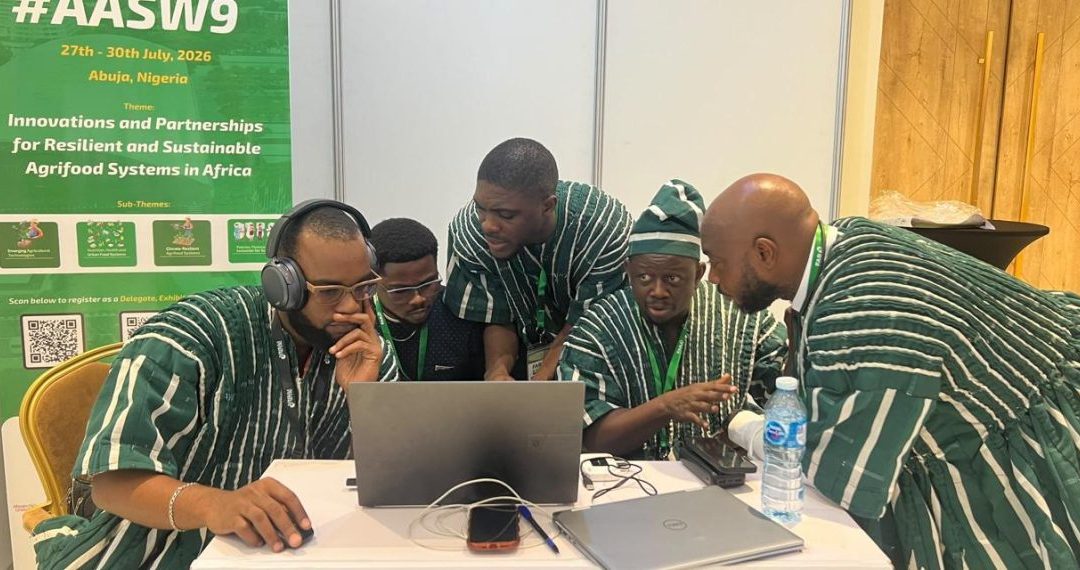
The 9th Africa Agriculture Science Week (AASW9) and the 10th General Assembly of the Forum for Agricultural Research in Africa (FARA) concluded successfully on 30 July 2026 at the Abuja Continental Hotel, Nigeria, with a renewed continental commitment to translate agricultural science, innovation and partnerships into measurable improvements in food security, livelihoods, resilience and economic development.
Convened under the theme “Innovations and Partnerships for Resilient and Sustainable Agrifood Systems in Africa,” the four-day event was organised by FARA with CORAF, the Agricultural Research Council of Nigeria and the Government of the Federal Republic of Nigeria, alongside continental, regional, national and international partners.
It brought together ministers, African Union representatives, national agricultural research systems, CGIAR centres, universities, farmer organisations, development partners, private-sector actors, innovators, investors, media practitioners, youth and knowledge-management professionals.
The conference programme addressed four interconnected sub-themes: emerging agricultural technologies and innovations; climate-resilient agrifood systems; nutrition, health and urban food systems; and enabling impact at scale through policies, financing, capacities, institutions and inclusion.
These themes were explored through high-level plenaries, ministerial and donor dialogues, parallel sessions, side events, exhibitions, science-policy exchanges, Nigeria Day activities and the FARA General Assembly.
A Broad and Influential Continental Gathering
AASW9 recorded 924 participants, comprising 822 delegates and participants and 102 service providers. Of the delegates for whom gender data were available, 546 were men and 276 were women, representing 66.4 per cent and 33.6 per cent respectively. Research and academic institutions accounted for approximately 70 per cent of participation, while policy actors represented about 12 per cent.
The programme included 25 side events and eight parallel or related sessions, with a cumulative attendance of 1,791 across the tracked sessions. Side events recorded 1,044 attendances, while parallel and other sessions attracted 747. An additional 312 participants joined selected sessions online.
The exhibition brought together 35 exhibitors, including 20 national agricultural research institutes and federal colleges and 15 international and regional organisations. Exhibitors showcased innovations in crop improvement, livestock, fisheries, forestry, mechanisation, seed systems, digital agriculture, extension, agroecology, climate-smart agriculture, value addition and agricultural value chains. (AASW9 Photo gallery)
Science Must be Connected to Delivery
Participants affirmed that African agricultural transformation requires more than the generation of research outputs and technologies. Effective innovation depends on functioning systems for validation, regulation, extension, financing, enterprise development, market access, knowledge exchange and public-sector implementation.
The conference therefore called for agricultural research performance to be measured not only by publications, studies and technologies released, but also by adoption, commercial uptake, productivity, resilience, incomes, nutrition, employment and inclusion.
At the opening ceremony, the Honourable Minister of Agriculture and Food Security of Nigeria, Senator Abubakar Kyari, CON, called for greater African investment in agricultural science, research and innovation. He stressed that Africa’s natural-resource endowments cannot generate prosperity without knowledge, innovation, enterprise and strong partnerships capable of converting scientific advances into practical benefits.
In his closing address, the Honourable Minister of State for Agriculture and Food Security, Senator Dr Aliyu Sabi Abdullahi, CON, reaffirmed FARA’s continental role, describing it as a “trusted voice of agricultural science.” His message underscored the need to sustain the partnerships, institutional relationships and implementation momentum generated during AASW9.
Key Outcomes and Commitments
1. The Abuja Clarion Call on Sustainable Financing for AR4D
Participants endorsed the Abuja Clarion Call on Sustainable Financing for Agricultural Research, Development and Innovation, recognising that fragmented and externally dependent financing cannot adequately support Africa’s long-term agricultural transformation.
The Clarion Call urges:
I. Progressively increased and predictable domestic investment in agricultural research;
II. The establishment or strengthening of agricultural development funds and other sustainable financing institutions;
III. African-led resource mobilisation for research and innovation;
IV. Stronger public-private partnerships for technology commercialisation and market-driven research;
V. Greater use of blended finance and other innovative financing instruments; and
VI. Deeper collaboration among FARA, the African Union Commission, AUDA-NEPAD, CGIAR, regional institutions, national agricultural research systems and partners.
The Government of Nigeria, through the Federal Ministry of Agriculture and Food Security, committed to championing an African-led resource-mobilisation process, including support for FARA’s efforts to establish an endowment fund to sustainably finance agricultural research, innovation and continental coordination.
2. Renewal of the Knowledge Management Partnership Framework
A major institutional outcome was the endorsement and signing of the renewed Knowledge Management Partnership Framework for Agricultural Research for Development in Africa, 2026–2030.
The framework brings together the African Union Commission; AARIEI partners, including FARA, AFAAS, ASARECA, CORAF, CCARDESA and NAASRO; CGIAR partners convened by ILRI and IITA; and the KM4AgD Community of Practice. It builds on the 2023–2025 framework and incorporates recommendations developed through institutional consultations and the KM4AgD community.
The renewed framework positions knowledge management as a strategic enabler of:
I. Adaptive learning and implementation intelligence;
II. Institutional coordination and decision support;
III. Interoperable digital knowledge infrastructure;
IV. Responsible artificial-intelligence adoption;
V. Capacity sharing and institutional strengthening;
VI. Respectful documentation and use of indigenous and local knowledge;
VII. High-value knowledge products and services; and
VIII. Evidence-based assessment of how knowledge contributes to agricultural transformation.
The participating institutions committed to collaborative implementation through annual planning, thematic working groups, shared digital platforms, consultation and learning processes, joint resource mobilisation and periodic review.
3. Scaling technologies and agricultural innovation
AASW9 called for stronger systems to identify, validate, finance, commercialise and scale technologies that respond to African priorities.
Discussions highlighted innovations in digital agriculture, artificial intelligence, soil intelligence, improved crop varieties, livestock production and health, biotechnology, mechanisation, renewable energy, irrigation, agroecology, climate-smart agriculture, extension services, post-harvest management and value addition.
Participants emphasised that technologies must be affordable, locally adaptable, inclusive and connected to reliable delivery systems. Research institutions, governments, farmer organisations, investors and the private sector were urged to collaborate throughout the innovation cycle rather than operate through isolated projects.
4. Climate resilience, soil health and sustainable natural-resource management
Participants recognised climate change, land degradation, declining soil fertility, biodiversity loss, water stress and extreme weather as major threats to Africa’s agrifood systems.
The conference called for:
I. Increased investment in climate-resilient technologies and farming systems;
II. Stronger soil-health information and advisory systems;
III. Expanded access to quality seeds and appropriate fertiliser recommendations;
IV. Improved climate information and early-warning systems;
V. Wider adoption of agroecological and nature-positive practices; and
VI. Stronger integration of indigenous knowledge with scientific evidence.
The Minister of State’s broader agricultural agenda has emphasised soil-health mapping, local testing capacity and data systems capable of providing farmers with location-specific recommendations.
5. Nutrition, health and inclusive food systems
The conference affirmed that agricultural transformation must be judged not only by increases in production, but also by improvements in nutrition, food safety, dietary diversity and public health.
Participants called for stronger links among agriculture, nutrition, health, education and urban planning. They also urged greater support for women, young people, persons with disabilities, smallholder farmers, pastoralists and other groups whose knowledge, labour and enterprises are essential to Africa’s food systems.
6. Stronger science-policy-business partnerships
AASW9 reinforced the need for structured partnerships linking research, extension, education, policy, finance and enterprise.
Participants called on governments and research institutions to create stronger pathways for private-sector participation in research priority-setting, technology validation, incubation, commercialisation and investment. Development-finance institutions, commercial banks, philanthropies and impact investors were encouraged to develop instruments that reduce the risks associated with financing agricultural innovation.
7. Renewal of FARA’s governance mandate
The 10th FARA General Assembly ratified the organisation’s Board of Directors for the 2026–2029 term, under the chairmanship of Dr Mark Cyubahiro Bagabe of Rwanda.
The Board includes representation from the FARA Secretariat, sub-regional research organisations, NAASRO, CGIAR, the African Development Bank, the African Union Commission, financial expertise, private-sector actors and farmers’ organisations. This composition provides a broad governance platform linking science, policy, financing, enterprise and producer perspectives.
Media and public engagement
AASW9 achieved considerable visibility beyond the conference venue. Across FARA’s tracked platforms, the event generated more than 332,868 impressions or reach and over 38,123 interactions and engagements. At least 162 content and media items were tracked across social media, online news, YouTube, radio and television.
This visibility demonstrated the importance of communication, media engagement and knowledge translation in ensuring that scientific and policy discussions reach practitioners, decision-makers and the wider public. (Day One Highlights; Day Two Highlights)
Resolutions and Way Forward
Participants resolved that the outcomes of AASW9 must now be converted into implementation through the following actions:
1. Consolidate the outcomes: Produce and disseminate a comprehensive conference report, communiqué, policy briefs, technical summaries and media-ready knowledge products.
2. Activate the Abuja Clarion Call: Engage African governments, development-finance institutions, private-sector partners and donors around sustainable financing for agricultural research and innovation.
3. Operationalise the Knowledge Management Partnership Framework: Develop an implementation plan, institutional roles matrix, priority workstreams, monitoring indicators and joint resource-mobilisation strategy.
4. Track commitments: Establish a structured outcome tracker covering declarations, agreements, pledges, partnerships, responsible institutions, timelines and reporting arrangements.
5. Strengthen national delivery: Connect continental discussions and innovations to national agricultural research, extension, policy, financing and market systems.
6. Scale proven innovations: Identify technologies and approaches with demonstrated impact and support their adaptation, investment, commercialisation and uptake across countries.
7. Improve inclusion: Strengthen the participation and leadership of women, young people, farmers, pastoralists, persons with disabilities and local knowledge holders in future AASW processes.
8. Improve future conference delivery: Begin preparation for the next AASW earlier, strengthen session reporting, improve exhibition-space integration, clarify participation packages and enhance traffic management and delegate engagement.
Closing Appreciation
The organisers express profound appreciation to the Government of the Federal Republic of Nigeria, the Presidency, the Federal Ministry of Agriculture and Food Security, the Federal Ministry of Livestock Development, the Agricultural Research Council of Nigeria, CORAF, participating ministries and agencies, the African Union Commission, AUDA-NEPAD, CGIAR, regional organisations, development partners, sponsors, exhibitors, speakers, session organisers, media institutions, service providers and delegates.
Special recognition is extended to the local and international organising teams and the many professionals whose work before and during the conference ensured the successful delivery of the event.
AASW9 has reaffirmed that Africa’s agricultural transformation must be science-led, innovation-driven, knowledge-enabled, partnership-based and sustainably financed.
The conference has concluded, but the Abuja mandate is only beginning: to move decisively from declarations to delivery and from innovation to impact at scale.
Source: CNR