

First Look at the African Union Soil Observatory (AUSO)
Background or Rationale
Across Africa, declining soil quality poses a serious danger to farming output, food security, rural economies, and local ecosystems. While overcoming these challenges calls for trustworthy and easy-to-access soil health information, existing soil information remains fragmented and unevenly developed across the continent. Consequently, researchers, government officials, and field practitioners struggle to accurately evaluate soil health conditions, monitor shifts, and deploy data-driven interventions.
To bridge this, the African Union Soil Observatory (AUSO)—an African-led initiative supported by the European Union—is working to build a continental system for integrating and sharing soil information. Building on the Soils for Africa (S4A) project, AUSO will bring together national and continental soil information via a Soil Health Dashboard and an African Soil Data Centre (ASDAC). By promoting FAIR principles, strengthening national soil information systems and developing accessible data products, AUSO aims to make soil data more discoverable, usable and valuable for decision-making across Africa.
The overall objective of workpackage (WP) 2 of the AUSO project is to establish a robust, user-centred foundation and enabling environment that develops, integrates and manages the AUSO project within the African Union system. By setting clear expectations for target audiences and users, as well as specifying the inputs required for the system, WP2 will directly shape the technical development taking place in WP4.
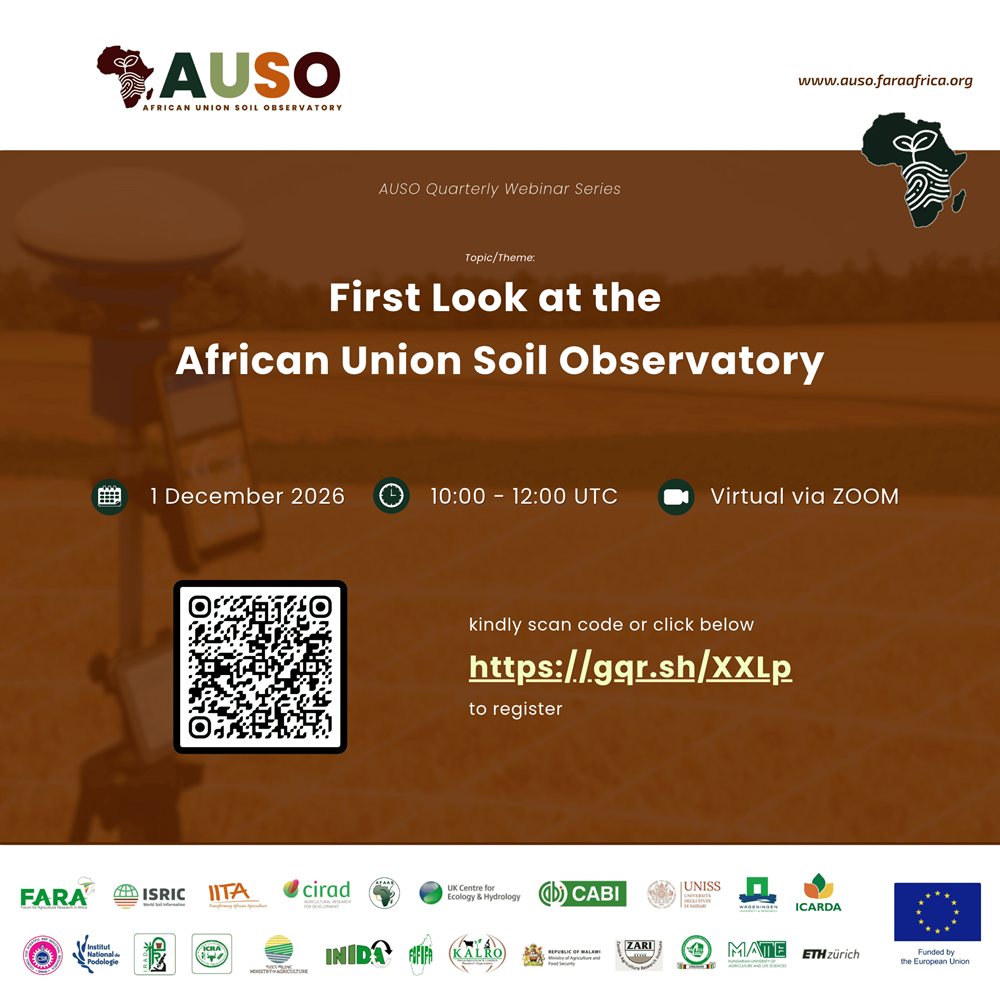
Development of the AUSO prototype is currently underway, with a scheduled completion date of April 2027. This upcoming session serves as a venue for gathering expert evaluations and end-user perspectives on the AUSO designs to steer future improvements, ensuring the final platform matches the needs of Africa’s soil data community.